Dian Fossey hike in Volcanoes National Park

The Dian Fossey Grave Hike is one of the outstanding activities there’s in the picturesque Volcanoes National Park of Rwanda. The hike will take the visitor through the most beautiful places of the National Park and also enable them to watch exciting creatures therein.

Visitors on the hike have the golden chance to set their eyes on most significantly the mountain gorillas and other exciting fauna species since they will be traversing through their habitat.

Volcanoes National Park as the host of the hike.

Volcanoes National Park is a remarkable destination in Rwanda. It hosts an incredible diversity of both plants and animal life. Visitors to Volcanoes National Park get immersed in the sensational beauty of the Virunga massif.

Travelers have the opportunity to indulge in a series of exciting touristic activities ranging from the most outstanding mountain gorilla tracking to hikes. Volcanoes is a host of five of the eight captivating Virunga Mountain ranges.

It is located in the northwest of Rwanda and spans an area of approximately 160 square kilometers.

Who was Dian Fossey?

Dian Fossey was a renowned primatologist. She rose to fame due to her exceptional work in the Virunga massif. She undertook extensive research about mountain gorillas between 1966 to the time she was murdered in 1985 by unknown assailants.

She dedicated her entire life to studying the lives of gorillas and other primates. She would do that regularly, and she deserves the credit for the booming gorilla tourism activities in East Africa today.

It was because of her works and ideas that gorilla habituation processes were undertaken in the Virunga conservation area, which has led to the exciting gorilla tourism activities such as trekking that many travelers enjoy in various national parks today.

Dian Fossey started the Karisoke Research Center, which is up-to-date and used by researchers from all corners of the world who wish to study primates in Volcanoes National Park.

The researcher spent 20 years in Rwanda studying mountain gorillas, and indeed her work didn’t go to waste.

She was a renowned lover of the mountain gorillas, and that is why when she died, she was buried close to her friends—the mountain gorillas who had also breathed their last. She indeed deserves the credit for her achievements. Travelers from time to time have hiked her grave in honor of the legend and her legendary works.

Hiking experience to the Dian Fossey gravesite.
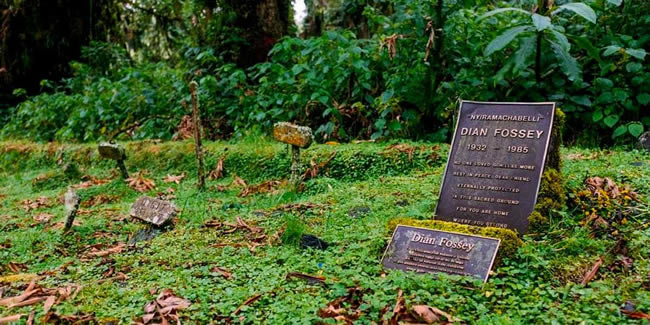
The hike to Dian Fossey’s gravesite is normally done in the morning. Visitors arrive at the park offices in Kinigi at around 7:00am when they get briefed about the activity by the ranger guides.

 The ranger guides provide travelers with information about the rules that govern the hike and what to do in case they meet wildlife species along the way.

The message is always about responsible travel and sustainability.

Visitors then embark on the hike at around 8:00 AM starting from the base of Mount Bisoke. Walking sticks are provided at the start of the hike at a free cost by the service providers at the National Park headquarters.

The walking sticks help support the visitor while on the hike and enable them to maneuver through the thick tropical rainforests and make their way through shrubs and mountainous terrain.

Travelers can also hire porters to help them carry their bags and personal equipment they’ll need throughout the hike.

While on the climb, visitors unveil the breathtaking views of the entire Virunga massif that are good for photography and videography, which usually act as souvenirs for the never-to-be-forgotten adventures in Africa.

Visitors will set their eyes on several wildlife species along the way, including primates and bird species, especially the African endemics.

The Dian Fossey gravesite is at 2967 meters above sea level, and it usually takes about two to three hours of determined hiking. The speed to the summit depends on the physical fitness of the hikers.

Best time to visit and the cost

The dry seasons are the most appropriate times in which one can embark on a successful and uninterrupted hike to the Dian Fossey gravesite. The dry seasons in Rwanda occur from early June to late September and from December to mid-March.

How to access the Dian Fossey grave site?

Esteemed travelers can drive to Volcanoes National Park. It takes only a 2-hour and 30-minute drive from Kigali International Airport to Volcanoes National Park.

On arrival at the park headquarters, continue to the base of Mount. Bisoke is where the hike starts. Mount Bisoke is only a 30-minute drive away from the park entrance.

10 Best Animals to See on a Game Drive: Murchison Falls National Park

Murchison Falls National Park is the biggest national park in Uganda today. Game drives are one of the best activities you can actually do in Murchison Falls National Park. The park is very big, and it has got a variety of different tracts that you can drive through to see a variety of bird species as well as different bird species in Uganda today. The best part of the game drives happens during the morning hours, when most of the animals are coming out to graze properly and have some water to quench their thirst. It gets more interesting when the animals are hunting down each other, especially among the hyenas and lions as well as the leopards. It is a magical moment truly best to watch during the game drives. The evening game drives give you a glimpse of various Giraffe animals to see in the park. The sun downer is amazing to watch as you enjoy a wonderful picnic evening in the park. In this article, we are going to be looking at the various animal species to see during either a morning or evening game drive in Murchison Falls National Park.

10 Best Animals to See on a Game Drive in Murchison Falls National Park

  • African Elephant

The African Elephant is the biggest creature you will find just living on the fertile soils of Murchison Falls National Park. They are not just massive but super smart too, and they live in these tight-knit groups like the coolest family you will have ever seen. Over at Murchison Falls, they just wander around the savannah like it’s their own backyard, hanging out in big, happy families. These guys are like the unsung heroes of the animal kingdom because they basically help the whole place stay in tip-top shape. They are like nature’s landscapers with their trunks that can do anything from munching on some leaves to taking a sip of water. And oh man, when they hit the Nile River, it’s like their personal spa day! They love to take a dip and have a drink there. The park’s been working really hard to keep these gentle giants safe from things like poachers and losing their homes. So, thanks to them, we can still catch these amazing sights in their natural habitat.

  • Rothschild’s Giraffe

Rothschild’s Giraffe also known as the Ugandan Giraffe are some folks call them, and is like the celebrity of the giraffe world because they are super rare. These animals have a cool look with a lighter coat and lower legs that are like, totally white with no spots. You can usually spot them hanging out in Murchison Falls National Park, which is like their own VIP club. They love to stay in savannahs and open woodlands, munching on acacia leaves like it’s nobody’s business. Thanks to some pretty awesome conservation efforts, this park has become their safe haven, and their numbers are looking up, which is great news. Watching a bunch of these long-necked beauties strolling through the park is like the ultimate Murchison Falls moment. It’s like nature’s own reality show, but way better. So, if you are ever there, don’t miss the chance to check them out.

  • Lion

The lion, recognized globally as the ‘king of the jungle, is one of the most powerful upper trophic level species found in Murchison Falls National Park. These beautiful big cats are solitary animals mainly seen in groups called prides, which is made up of related females and their young and several males. Due to hunting and poaching, big cats like lions are facing many challenges, which make them important in the preservation of the balance in the ecosystem in that they feed on prey animals. In the park they like areas that provide good cover when hunting, areas such as grasslands and regions with a lot of shrubs. Lions are cats to behold; whether they are literally taking the sun or hunting, you get to see the strength and the social skills of the cats of the wild.

  • Nile Crocodile

The Nile crocodile is another reptile species that is well known to be among the largest and most aggressive living crocodiles. These wildlife species are well known to inhabit the area beside the Nile River in this park. Nile crocodiles have strong necks and are stalk hunters and therefore are very effective hunters of fish, birds, and any mammal that comes close to the water line. They are also carnivores and are useful animals in the community and ecosystem since they help in the decomposition of carrion. These crocodiles can mainly be seen by visitors sunning on the river borders or gracefully moving in the river water, a feature that enhances their paleo-archaic attraction.

  • Hippopotamus

Hippos, scientifically termed as hippopotamuses, are some of the most famous animals found in Murchison Falls National Park. These massive herbivores are mostly found to spend most of their time in water to avoid getting a sunburn on their skin. They are animals that are predominantly social, and they inhabit social groups that are referred to as pods. Domesticated animals as they may appear, hippos have one of the most vicious dispositions and are involved in many deadly attacks in Africa. The fact that they are widely located in the regions of the Nile River and its branches can be interesting for tourists, despite severe tension and fear, to meet such animals.

  • Cape Buffalo

The Cape buffalo, or African buffalo, is a large, powerful bovine that lives in large herds in the grasslands as well as woodland regions of the park. These creatures are well regarded by predators as well as the people because of their erratic behavior. This is because, like with most social groups, for instance the Buffalo herds, they form large groups for safety. The prospect of having to encounter an incredibly large group of animals in a certain area when out on a hunting expedition is encouraging, yet at the same time, somewhat threatening. It hosts a number of wild animals and such precious breeds of the buffalo that not only dictate the vegetation cover but also act as great prey to lions and other large carnivores.

  • Leopard

Other big cats perched at the top of Murchison Falls National Park’s food chain include the leopard, which is a reclusive and rare large felid. Leopards can easily blend into their surroundings because they are covered in beautiful spots on their shiny black fur. They are mainly active during nighttime and will catch their prey during nighttime as well, dragging the body of the prey up a tree to tender for vultures. Leopards are versatile creatures of the African wild living in different ecosystems, including the riverine forest and savannah. A person will need to be very lucky to meet a leopard in the natural environment because these animals take all measures to ensure that they do not come across people.

  • Ugandan Kob

The Ugandan Kob is a beautiful, chill antelope that’s basically the poster child for Murchison Falls National Park. They have got these pretty reddish-brown coats, and the dudes have some fancy lyre-shaped horns, which are like their crowning glory. These guys just love to hang out and munch on grass in wide open spaces, especially around watering holes where they can chill with their buddies. When it’s time to find a date, the male Kob’s go all out with flashy moves to catch the ladies’ attention. It’s like their own little dance party, but with life and death stakes.

A Journey to Murchison Falls National Park

A Journey to Murchison Falls National Park. Encompassing over 3,840 km² of unspoiled terrain on both banks of the Nile River, east of Lake Albert and west of Karuma Falls, Murchison Falls National Park is among Uganda’s most ancient and expansive protected places. The park is well-liked by people who enjoy the outdoors and safari travel because of its high biodiversity and abundance of species. Along with a variety of antelopes, giraffes, and Uganda kobs, it is home to four of the Big Five game animals: lions, elephants, and buffaloes. The adjacent Budongo Forest Reserve offers visitors the chance to see chimpanzees and other primates, giving the park a rare combination of savannah and forest environments.

The park’s most striking feature is the Murchison Falls, where the Victoria Nile tumbles through a small valley. As the river crashes through a 7-meter-wide valley and drops 43 meters with a loud boom below, its strong surge of water creates a magnificent scene on its route reaching Lake Albert.

Here is a comprehensive guide to planning a safari in Murchison Falls National Park.

Getting There

The park is situated on Uganda’s western border and is around a five-hour drive from Kampala, the country’s capital. You can get to the park by plane or by car. The park’s Pakuba Airstrip is served by daily flights from Entebbe International Airport. As an alternative, you might rent a car and go to the park by car. The drive is picturesque and provides a view of Uganda’s rural areas.

Accommodation

There are several lodging alternatives, from affordable to luxurious, in and around the park. Paraa Safari Lodge, Chobe Safari Lodge, and Pakuba Safari Lodge are a few of the well-known lodges. The park offers campsites for people who would like to camp. Campers can enjoy a distinct experience as they are merely separated from the natural world and park inhabitants, like lions, elephants, and hippos, by a thin canvas tent. Here is what you need to know about the lodges in Murchison Falls National Park.

Paraa Safari Lodge

In the center of the well-known Murchison Falls National Park, Pakuba Safari Lodge is a five-star lodging establishment tucked away in northern Uganda that provides an amazing safari experience. This magnificent lodge offers guests panoramic views of the verdant surroundings and the abundant wildlife that frequents the area. It is well situated along the eastern bank of the Albert Nile.

Sambiya River Lodge                                                                        

The Sambiya River Lodge is a peaceful and quaint lodging option in Murchison Falls National Park. Its landscape and abundance of wildlife make it the perfect area for those who want to experience the beauty and splendor of the African bush up close.

Fort Murchison Lodge

The lodge has a great historical feel to it, as it is named after the historical ruins of an old British colonial fort that formerly stood nearby. It offers a special fusion of luxury and adventure, which makes it the perfect location for individuals who love the outdoors and those looking for a peaceful getaway in the middle of Africa.

Activities

Murchison Falls National Park offers a wide range of activities for visitors. Some of the popular activities include

Game Drives

Murchison Falls National Park provides a thrilling game drive experience among its varied species and beautiful scenery. These excursions are undertaken by visitors in sturdy 4×4 vehicles that are built for traversing the rough terrain of the park and offer unhindered views of the diverse ecology. Traveling around the park in the early morning or late afternoon with knowledgeable guides, visitors see a range of magnificent creatures, including as lions, giraffes, elephants, and other bird species.

Traveling through the park’s savannah grasslands and forests and along the Nile River, ending at the magnificent Murchison Falls, offers an once-in-a-lifetime chance to experience the majesty of nature up close. The experience is further enhanced by Murchison Falls National Park’s dedication to conservation and ethical tourism, which emphasizes the significance of maintaining the park’s natural habitats and safeguarding its endangered species.

Boat Cruises

As passengers set sail on the serene waters of the Nile River, they are met with a symphony of colorful fauna and magnificent natural beauties. Visitors are treated to an up-close encounter with the park’s rich biodiversity as the boat glides along the winding river; they may spot hippos, crocodiles, and a variety of bird species, including the elusive shoebill stork. The voyage ends with a beautiful view of the famous Murchison Falls, where the powerful Nile thunderously cascades down a tight valley, captivating the senses and leaving a lasting impression on all visitors.

Hikers

In Murchison Falls National Park, a variety of trails weave through the park, offering hikers the chance to see a wide range of animals, such as lions, giraffes, elephants, and several bird species. A particularly thrilling experience is the hike to the top of the falls, where guests may take in the stunning exhibition of nature’s force as the mighty Nile River carves through a gap that is only 7 meters wide.

Bird watching

Observing native and migratory birds in their natural habitat is possible through bird watching at Murchison Falls National Park. With over 450 kinds of birds identified, birdwatchers go from all over the world to this park in hopes of catching views of elusive and rare avian species. The shoebill stork, the goliath heron, the Abyssinian ground hornbill, and the famous African fish eagle, famous for its unusual call are a few of the noteworthy bird species that may be seen in the park.

Best Time to Visit

When visiting Murchison Falls National Park, the best months to go are December through February and June through September, which is known as the dry season. The park’s fauna is more gathered around water sources during this time, which facilitates viewing.

Conservation Efforts

With a rich past, Murchison Falls National Park served as an affluent person’s hunting paradise in the first part of the 1900s. To safeguard the park’s fauna and ecosystem, conservation measures have been implemented, and the park is now a part of the larger Murchison Falls Conservation Area. A portion of the gate fees (20%) is returned to the community in addition to programs for employment and education. Murchison Falls National Park’s restoration has created a strong basis for the park’s long-term future.

In conclusion, everyone considering a safari in Uganda ought to make time to visit Murchison Falls National Park. In addition to the beautiful scenery, the park’s wildlife and conservation initiatives provide visitors with a unique experience. Numerous activities are available to visitors, including as hiking, wildlife drives, and bird watching. Visitors can enjoy a memorable time at Murchison Falls National Park with appropriate preparation.

Serengeti National Park Facts

The raw beauty of Africa’s wilderness can be witnessed by the Serengeti National Park, which is tucked away deep within Tanzania. Known for its beautiful landscape, varied fauna, and historic ecosystems, this well-known park covers an area of more than 14,750 square kilometers. Adventurers and activists find the Serengeti to be incredibly attractive, with its wide plains interlaced with acacia trees, stunning kopjes, and bending rivers. In this piece, we explore the amazing details that contribute to the Serengeti National Park’s status as a biodiversity treasure and a wildlife lover’s paradise.

The Great Migration, one of the most amazing animal exhibitions on Earth, is closely linked to Serengeti National Park. A magnificent display of movement and survival is produced every year when millions of wildebeest, zebra, and gazelles cross the plains in search of better pastures. This magnificent migration serves as a powerful example of the adaptability of Africa’s fauna as well as the interdependence of all the species in the Serengeti ecosystem. The park offers visitors unique chances for animal viewing and photography because it is home to a multitude of other iconic species, such as lions, elephants, giraffes, and cheetahs, in addition to the migratory herds.

Beneath the endless skies of Serengeti National Park is a geological variety shaped by millions of years of natural processes. From the ancient volcanic formations of the Gol Mountains to the beautiful Maasai kopjes, the park’s landscapes offer a look into the erratic past of the planet. The Ngorongoro Crater, a massive caldera teeming with wildlife and surrounded by steep walls that act as a natural enclosure for its inhabitants, is one of the park’s most iconic features. These varied landscapes combine to create a sanctuary for an extensive number of species while also adding to the park’s unbeatable beautiful scenery.

Serengeti National Park is one of the most famous protected areas in the world and a UNESCO World Heritage Site, but it also faces many conservation challenges. Poaching, habitat degradation, and conflict between humans and wildlife are some of the ongoing threats to the park’s fragile ecosystems and the species that call it home. Nevertheless, thanks to the tireless efforts of conservation organizations, local communities, and park rangers, great progress has been made in preserving the park’s natural heritage. Conservationists are working to ensure that future generations can enjoy the wonders of Serengeti National Park.

Facts about Serengeti National Park

  • The Great Migration, the world’s greatest terrestrial mammal migration, takes place in the Serengeti National Park. Each year, hundreds of thousands of zebras and gazelles, as well as about 1.5 million wildebeest, travel throughout the Serengeti ecosystem in quest of new grazing areas. This remarkable trip, which spans around 800 kilometers, highlights the animals of Africa’s extraordinary adaptation and persistence.
  • In 1981, Serengeti National Park received the UNESCO World Heritage Site designation. This esteemed designation recognizes the park’s remarkable biodiversity, ecological importance, and cultural legacy, guaranteeing its preservation for the enjoyment and amazement of future generations.
  • All five of the famous Big Five—lions, elephants, leopards, rhinoceroses, and African buffaloes—can be found in the Serengeti National Park. These famous animals are among the most sought-after sightings for visitors exploring the park’s expansive woods and savannas. They symbolize the highest levels of African wildlife.
  • The environment of the Serengeti was crucial in forming our knowledge of evolutionary biology. Modern conservation science has its roots in this area, where scientists like Bernhard Grzimek and George Schaller conducted innovative research that shed light on animal behavior, population dynamics, and predator-prey relationships.
  • The vast grasslands of the Serengeti, which stretch forever into the distance, are widely associated with the African wilderness. These vast grasslands, which are characterized by short grasses and occasional acacia trees, provide the main habitat for the park’s resident herbivores and support a complicated web of life that keeps numbers of both predators and prey.
  • The Serengeti National Park is a wonderland for naturalists and photographers hoping to get up close and personal with lions, cheetahs, leopards, and hyenas because it has one of the greatest densities of predators in Africa. These apex predators find great hunting grounds in the park’s varied landscapes, which also present plenty of chances to see the African savanna’s dynamic opening.
  • Encased in undiscovered resources that date back thousands of years are the granite outcrops of the Serengeti. Old rock art sites, like those in the Moru Kopjes, provide insights into the cultural legacy of the area’s first residents. These sites show depictions of hunting, rituals, and everyday life that were cut into the stone by ancient hands.
  • Birdwatchers and ornithologists will find the afterlife in Serengeti National Park, which has over 500 bird species reported inside its borders. The park’s varied birds highlight the great biodiversity of East Africa’s skies, with majestic raptors flying overhead and colorful songbirds darting among the branches.
  • A wonderful sight occurs every year when millions of ungulates cross rivers teeming with crocodiles and starving predators in a never-ending search for survival. This is the wildebeest migration. For those who love wildlife, seeing this incredible event up close is a once-in-a-lifetime opportunity that will deepen their understanding of the resiliency and persistence of Africa’s animal kingdom.
  • George Schaller launched the Serengeti Lion Project in the 1960s, and it is still one of the longest-running studies of large carnivores in the wild. Researchers have contributed to ongoing efforts to protect these magnificent predators by gaining unique insights into the behavior, ecology, and conservation needs of the iconic lion population of the Serengeti via decades of careful fieldwork and scientific observation.
  • The Great Wildebeest: The calving process is another amazing natural event that takes place on the southern grasslands of Serengeti National Park every year from January to March. Predators and photographers alike are drawn to the grasslands as hundreds of thousands of expectant wildebeest congregate to give birth simultaneously, bringing with them the sights and sounds of new life.
  • For thousands of years, human cultures have lived in the Serengeti ecosystem, leaving their cultural legacies, ancestors’ knowledge, and archeological sites as evidence of their presence. The Maasai people still have a strong spiritual bond with the land and its inhabitants, and they live together with the local wildlife today.

Conclusion

The wonders of Serengeti National Park serve as a constant reminder of the interdependence of all life on Earth and the value of conservation in preserving it for future generations. The vast expanses of the Serengeti captivate the hearts and imaginations of anyone who travels through it, whether it is through the distant roar of a lion on the plains or the silent beauty of a baobab tree against the African sky. The Serengeti is a timeless symbol of Africa’s wild beauty and the ongoing heritage of our planet’s natural valuables. By continuing to support conservation initiatives and sustainable tourism practices, we can ensure that Serengeti remains a light of hope and inspiration for centuries to come.

A Safari to Rushaga Sector | Bwindi Impenetrable National Park

A safari to Rushaga Sector, Bwindi Impenetrable National Park. Right in the midst of Africa’s fresh vegetation and uncontrolled wildlife is a beautiful national park that conserves life as well as diversifies it, Bwindi Impenetrable National Park. The mystical National Park measures about 320 square kilometers of a tropical and subtropical region with various ecosystems in southwest Uganda. The park is also a world heritage site protected by UNESCO but, due to its flora and fauna diversity, should be visited by everyone, including natural lovers and adventurers.

It is exciting to go on a safari to the beautiful Rushaga Sector in the park and meet the mighty mountain gorillas as well as explore this natural wonderland.

Setting the Scene in Bwindi

Bwindi is, however, more than what it looks like, as beauty goes hand in hand with its importance. It plays an important role in the conservation chain protecting a mixture of montane and savanna/lowland forest systems. Half of all endangered mountain gorillas in the entire world live here in Bwindi, illustrating how serious Uganda is about safeguarding its diverse natural legacy and heritage.

Rushaga Sector

In the midst of the spread beauty of Bwindi we find Rushaga sector; a place with differentiated terrain features. This is a visual experience that starts at the very entrance into the sector. It continues all through as you take part in an extremely memorable safari adventure. This sector is a top choice for ecotourism since it offers a diversity of habitats for different fauna, from thick forests to vast grasslands.

Here are the things to discover on your safari to Rushaga.

The Gorilla Encounter

Without doubt, the key feature of Rushaga Sector is the possibility to trek mountain gorillas, in their environment. They trek through the green vegetation, watching these peaceful and calm animals in their families while experiencing a unique experience. It is only when one is walking through the thick forest that one realizes how fragile the ecology is. Every traveler is profoundly impacted by the experience of walking among the verdant, thick trees, and when we get up close to this kind, massive creatures, the experience is truly unforgettable. The experience with the gorillas is only the start of a symphony of biodiversity waiting to be discovered.

Flora and Fauna Diversity 

Uganda demonstrates its efforts in preserving the nation’s natural heritage through its presence in Bwindi. About four hundred plant species including many endemics inhabits the park. Within its boundaries are some rare and endangered animals species like the eastern chimpanzee, L’Hoest’s monkey, and African forest Elephant which contributes to its importance globally as a biodiversity hot spot. Bwindi represents life’s symphony wherein each rustle in the under-story and each animal call is a contributor.

 The biodiversity of Rushaga sector exceeds that of the famous gorillas. It is home to many different varieties, including plants and animals that are quite rare; hence forming a sensitive balance for all the organisms in the region. Each step reveals something different, from colorful butterflies moving through the wind to evasive forest elephants maneuvering through thick bushes.

Birdwatcher’s Paradise

Over 350 bird species are found in Rushaga Sector, making it a heaven for bird enthusiasts. Beautiful hues of plumage come and go against each other in a playful dance to the sounds of melody that fill the air. The transition from one bird sighting to another makes the park come alive and showcases the web or connectivity of its constituents. It’s a symphony of Nature as you transition from one bird sighting to the other; all who visit are involved in this whole experience. However, there is a quiet but forceful conserving power in Bwindi that leads to tomorrow’s development.

Cultural Encounters

Besides the beautiful scenery and exotic animals, a visit to Rushaga sector reveals more about the culture of the country. The locals, as proud caretakers of their ancestry, readily receive outsiders with affection in addition to narrating tales from years past which collectively comprise their existence. In many activities the most vibrant locals would be the Batwa people and Ride for Women who support the local women in tourism. In the wake of the twilight after the expedition to the Rushaga Sector, one can only imagine the implication of responsible tourism.

Conservation Efforts

The impenetrable Bwindi National Park is a stronghold of environmental preservation. To protect the delicate balance between human activity and the preservation of the park’s distinctive environment, park rangers and the surrounding community work together. Responsible tourism is highlighted in guided tours as the tourists become the advocates of protection of the park. Bwindi is more than just an illustration of how Ugandans protect their environment; it is an example of people’s collaboration with their environs.

Nonetheless, Bwindi’s beauty is not free of its problems. The activities such as poaching, habitat loss, and human-wildlife conflicts will continue to pose danger to conservation efforts. Nevertheless, the park remains an exemplary case of successful conservation activities. Collaboration between government bodies, local communities, and international organizations has not only ensured that the numbers of mountain gorillas increase but also demonstrated the resilience of Bwindi’s ecosystem. The ongoing battle for conservation underscores the importance of responsible tourism in safeguarding the park’s future.

Planning Your Safari

Planning a safari in Rushaga sector requires utmost diligence and precision. Acquire secure permits early, pick proper hiking equipment, and deal with well-respected tour operator agents. The trip to Bwindi Impenetrable National Park is one that blends on anxiety and preparedness, ensuring each visitor is fully ready for an awe-inspiring experience.

Conclusion

Bwindi Impenetrable National Park serves as an illustration of how delicate balance between nature and conservation can be possible in such dense forestry, with great diversity in both fauna and flora. In our journey to the famous Rushaga Sector of this park, one will be thrown back into the past while the current times come alive, for each movement on the undergrowth speaks of strength and victory. The expedition is not merely an adventure but rather a promise to conserve wonders that are a ray of hope for the ecosystem in Bwindi.

Best Destinations to Visit in Tanzania

Tanzania is a country with outstanding scenery and a wide variety of cultures, located in the center of Africa. Tanzania provides several exciting locations for tourists looking for life-changing experiences. Its varied landscapes range from the famous Serengeti plains to the dramatic heights of Mount Kilimanjaro. Discover the hidden treasures and well-known delights that make Tanzania a must-visit location for every passionate traveler as we explore into the amazing mix of wildlife, culture, and adventure in this investigation of the country’s top travel attractions.

Among Tanzania’s many natural valuables, the Serengeti National Park is the pearl in the crown. The Serengeti is known for its amazing chances to see wildlife, especially during the Great Migration. It covers an area of about 14,750 square kilometers of expansive savannah grasslands. It is quite amazing to see the yearly migration of millions of zebras, gazelles, and wildebeest as they travel over the plains in search of pastures with better conditions. Beyond the migration, the Serengeti guarantees guests an amazing safari experience by allowing them to come into close proximity with Africa’s famous Big Five: lions, elephants, buffaloes, leopards, and rhinoceroses.

The island of Zanzibar encourages travelers looking for a distinct kind of adventure with a distinctive blend of culture, history, and beautiful shores. Zanzibar has a diverse range of influences from Arab, Persian, and European cultures, which are evident in its architecture, gastronomy, and way of life. Discover Zanzibar’s exciting past by meandering through the winding streets of Stone Town, a UNESCO World Heritage Site including thriving markets and architecture extending back centuries. The island’s beautiful beaches, which are surrounded by swaying palms and turquoise waters, make the ideal setting for relaxation and water sports like diving, snorkeling, and boat cruises.

Here are the Best Destinations to Visit in Tanzania

Serengeti National Park

    The Serengeti National Park is an eternal image of the wild, raw beauty of Africa. Its enormous plains are home to the Great Movement, the world’s biggest wildlife movement, during which millions of zebras, gazelles, and wildebeest travel across the region in search of new grazing sites. Even outside of the migration, the Serengeti is home to an unsurpassed variety of animals, including the Big Five, giving tourists the opportunity to see exciting predator-prey interactions and have once-in-a-lifetime safari experiences. Its expansive views of the savannah, broken up by rocky outcrops called kopjes, make for a famous setting for game drives and wildlife photography, and its luxury lodges and tented camps provide unparalleled luxury in the middle of nature.

    Ngorongoro Crater

    A UNESCO World Heritage Site, the Ngorongoro Crater is one of Tanzania’s most amazing natural wonders and is sometimes referred to as “Africa’s Eden.” A remarkable concentration of wildlife, including large populations of elephants, buffalo, and wildebeest as well as predators like lions and cheetahs, may be found in the rich plains and dense vegetation of the crater, which was created by the collapse of an ancient volcano. Safari drives allow travelers to drive down into the crater, where they will find a variety of habitats surrounded by the striking crater walls, from grassy plains to acacia woodlands and soda lakes. Experiences in the culture of the Maasai people, who coexist peacefully with the wildlife, strengthen the Ngorongoro Conservation Area experience.

    Mount Kilimanjaro

    Climbing to the top of Africa, Mount Kilimanjaro encourages travelers from all over the world to experience the magnificent view of its snow-covered summit. Kilimanjaro, the tallest freestanding mountain in the world and the highest peak in Africa, has a variety of hiking routes that suit varying fitness levels and tastes. Upon reaching Uhuru Peak, climbers are rewarded with beautiful views and a great sense of accomplishment, regardless of whether they are rising through thick rainforests, glacier meadows, or stark lunar landscapes. Trekkers face both physical and mental challenges on their climbing, with knowledgeable guides ensuring their safety and success at every turn.

    Tarangire National Park

    Northern Tanzania’s Tarangire National Park is well-known for its plentiful animals and beautiful landscapes. Massive numbers of elephants, lions, leopards, and various bird species can all be found at Tarangire, providing great game viewing possibilities, especially during the dry season when animals gather along the Tarangire River. The recognizable baobab trees of the park stretch out to the horizon, creating an exquisite backdrop for photography safaris and well-guided walking excursions conducted by Maasai guides. Tarangire National Park is an enigma waiting to be discovered for those looking for a more personal safari experience away from the masses.

    Lake Manyara National Park

    A little but stunning, Lake Manyara National Park is well-known for its wide variety of ecosystems and rich birdlife. The small alkaline lake, the focal point of the park, draws thousands of flamingos and other water birds, resulting in a stunning display of pink hues. Past the lake lies the park’s rich groundwater forests, full of baboons and elephants, and dense woodlands inhabited by lions that climb trees. Experience yourself in the natural beauty and peace of this wonderful environment by going on game drives, walking safaris, or canoeing trips along the quiet waters of the lake.

    Selous Game Reserve

    The largest protected game reserve in Africa, the Selous Game Reserve is a sanctuary for safari lovers looking for off-the-beaten-path experiences, with a landmass larger than Switzerland. The reserve, which bears the name of the renowned British explorer and conservationist Frederick Selous, is distinguished by its enormous, intact wilderness, varied ecosystems, and variety of animals. In the Selous, guests can take boat safaris down the Rufiji River, where hippos wallow in muddy pools and crocodiles savor their daily repast of sandbanks or go on guided walking safaris into the bush, where they can track wildlife on foot and discover the intricate details of the environment. Away from the visit, Selous offers a fully authentic safari experience thanks to its distant position and flawless environment.

    Ruaha National Park

    Central Tanzania’s Ruaha National Park is one of the biggest and least frequented national parks in the nation, making it an oasis for adventurous tourists looking for wilderness experiences. Ruaha provides game viewing possibilities in a remote and natural setting with its rough terrain, varied sceneries, and rich wildlife, which includes significant populations of elephants, lions, and rare antelope species like sable and roan, among others. While resting in upscale tented camps and lodges, visitors can take game drives, walking safaris, or fly camping tours within the national park to fully experience the sights and sounds of the African wilderness.

    Conclusion

    Tanzania is a traveler’s paradise, with environmental beauties, cultural attractions, and thrilling events to suit all tastes. Tanzania’s varied travel locations engage the mind and create an enduring impression on people who go here, from the famous grasslands of the Serengeti to the incredible heights of Mount Kilimanjaro, from the historical beauty of Zanzibar to the lonely wilderness of Ruaha and Selous. Tanzania offers travelers incredible experiences that highlight the diversity of life on the African continent, whether they choose to experience the drama of the Great Migration, climb Africa’s highest peak, or visit chimpanzees in their forest sanctuary. Visitors engage with the locals and discover the country’s surroundings, supporting conservation efforts to protect Tanzania’s

    Best Time to Visit Tanzania

    Tanzania, a country in East Africa, is renowned for its outstanding scenery and diversity. From the recognizable Serengeti plains to the amazing heights of Mount Kilimanjaro, this magical nation provides travelers with an experience they won’t soon forget. Tanzania is well-known for its unique cultural fabric, with a dynamic mosaic of ethnic groups that each add their own traditions and rituals to the national identity. Tanzania promises to engage your senses and make a lasting mark on your soul, whether you’re looking for wildlife encounters, deeply engaging cultural experiences, or just somewhere to relax and enjoy the sun on gorgeous shores.

    Tanzania’s amazing wildlife is without hesitation one of its greatest assets. Some of the most well-known national parks and wildlife reserves in the world, such as the spectacular Ngorongoro Crater and the famous Serengeti, are located in this nation. The Great Migration, which sees millions of wildebeest, zebras, and other creatures crossing the plains in search of fresh pastures with the constant presence of predators, is an amazing sight to behold. Take a safari visit and see the purest splendor of nature as you come across giraffes gently grazing against the backdrop of a red African sunset, elephants wandering across the grassland, and lions basking in the sun.

    Tanzania has a diverse range of cultures and customs that are just waiting to be discovered, in addition to its amazing wildlife. The country’s cultural legacy is as varied as it is exciting, from the lively Maasai people dressed in their amazing clothes to the infectious sounds of Swahili music filling the air. Participate in intensive cultural experiences to interact with local people and learn about long-standing traditions that have been passed down through the centuries. You can also sample real cuisine and learn traditional dances. Tanzania provides a wide variety of experiences that will leave you fascinated and enlightened, whether you’re visiting the busy marketplaces in Dar es Salaam or meandering through the tiny pathways of Stone Town in Zanzibar.

    Beyond its savannahs and varied cultural settings, Tanzania is renowned for its spectacular coastline and beautiful islands. With its beautiful white sands and crystal-clear waters, Zanzibar’s beaches are the ideal setting for rest and regeneration. Explore the lively underwater environment of the Indian Ocean, where colorful coral reefs brim with an abundant amount of marine life and provide unrivaled chances for diving and snorkeling. Tanzania’s seaside paradise calls out with its attractive attractions, delivering a wonderful getaway from the worries of everyday life, whether you’re seeking anticipation on the water or quiet on the shore.

    The Ultimate Guide: When to Visit Tanzania for an Unforgettable Adventure

    Peak Season (June to September)

      The dry season in Tanzania, spanning from June to September, is widely regarded as the peak tourist season. With clear skies and minimal rainfall, this period offers excellent conditions for wildlife viewing and outdoor activities. The famous Great Migration, where millions of wildebeests and zebras traverse the Serengeti in search of greener pastures, typically occurs from June to August, making it a prime time for safari.

      Tanzania’s northern circuit, including the Serengeti National Park, Ngorongoro Crater, and Tarangire National Park, experiences high tourist numbers during this period. It’s advisable to book accommodations and safari tours well in advance to secure your spot and avoid disappointment.

      Shoulder Seasons (October to December, February to March)

      The shoulder seasons, October through December and February through March, offer a nice combination of good weather and fewer crowds, so anyone looking for a more leisurely experience can definitely consider them. Following the brief November rains, the savannah is covered with lush, green scenery during these months, offering magnificent views.

      As the dry season draws to an end in October, animals gather around water sources, making for great opportunities to see game. The abundance of bird species that thrive in Tanzania’s varied ecosystems will also please birdwatchers.

      As the long rains approach in February and March, the plains become covered in newborn animals, and nature becomes a green paradise, giving safaris a special charm. These months are especially popular for visiting the southern circuit parks, such as Ruaha National Park and Selous Game Reserve, which offer private safari experiences alongside amazing scenery.

      Low Season (April to May)

      April to May constitutes the low season in Tanzania, characterized by the long rains. While this period experiences heavy rainfall and some lodges and camps may close temporarily, it presents opportunities for budget-conscious travelers to enjoy discounted rates and exclusive experiences.

      A photographer’s dream, the beautiful landscapes of the green season offer many creative opportunities with their vibrant hues and dramatic skies. The silence and calm of the parks provide a fully authentic wilderness experience, even while animal encounters may be less reliable due to the dense vegetation and animals scattering across bigger areas.

      Cultural Festivals

      Tanzania is known for its natural beauty, but it also has a diverse range of cultures and customs that are honored all year long through a number of festivals and events. Mock battles and cultural performances, along with other ancient Swahili practices and rituals, are showcased during Zanzibar’s Mwaka Kogwa festival in July, offering an insight into the island’s background.

      The Zanzibar International Film Festival (ZIFF), typically held in June or July, attracts filmmakers, artists, and enthusiasts from around the world, offering a platform for showcasing African cinema and promoting cultural exchange.

      Conclusion

      Finally, Tanzania offers a variety of experiences that suit the interests of all types of travelers, making it an enticing destination year-round. Tanzania delivers an unforgettable experience, whether you’re delighted with the sight of the Great Migration, attracted by the quiet of the green season, or happy about the colorful weaving of cultural celebrations.

      Travelers can customize their trip to suit their interests and expectations by learning about the subtle differences between each season, from the busiest time of year for wildlife to the peaceful low season. Tanzania’s varied landscapes and friendly people will make a lasting impression on your spirit, whether you choose to go on a safari across the Serengeti plains, climb Mount Kilimanjaro, Africa’s highest peak, or just absorb yourself in the lively life of Zanzibar.

      How long does gorilla trekking take?

      How long does gorilla trekking take? Uganda has Bwindi Impenetrable National Park in the southwest of Uganda, which is among the top destinations where tourists take trekking of the gorillas. Half of the total mountain gorillas that currently remain in the whole world are found in Bwindi, and it will be quite fascinating to watch these gorillas move in the jungle as they swing from one tree to another. However, one of the most common questions potential trekkers ask is, ”Questions to note include: How long does it take to trek the gorillas in Bwindi? “In this circumstance, this article is going to describe the areas that one has to understand concerning the time that is used in an actual gorilla trek in Bwindi Impenetrable National Park.

      Introduction to Gorilla Trekking in Bwindi

      I think many people out there would also concur with me that gorilla trekking in Bwindi is unusual. The exercise of trekking involves climbing steep hills to get to the group of the gorillas; this is both exciting and satisfying. Bwindi Impenetrable National Park can be found in the southwestern part of Uganda, occupying an area of 321 square kilometers, and this makes it part of the UNESCO World Heritage Site. The park is divided into four main sectors for gorilla trekking: Buhoma, Ruhija, Rushaga, and Nkuringo. Duration of Trekking There is variation in the trekking of each sector, and maybe the time is just altered by some facts.

      Factors Influencing the Duration of Gorilla Trekking

      Terrain and Trekking Routes

      Bwindi Impenetrable National Park is one that has steep slopes, meaning the terrain in one sector is different from the other. The routes can begin comparatively easy and then become progressively difficult, or the routes can begin very hard from the beginning. It might also be assumed that the trekkers will be able to endure such obstacles as thick-grown vegetation and a slippery track together with steep slopes arranged by the organizers of this kind of trekking. The time it takes to get to the gorillas could even be as little as 30 minutes up to 7 hours, depending on the particular path as well as the sector.

      Buhoma Sector

      This sector is known for its relatively easier trails. Treks here can take between 2 to 5 hours.

      Ruhija Sector

      The terrain in Ruhija is moderately challenging, with treks typically lasting between 3 and 6 hours.

      Rushaga and Nkuringo Sectors

      These sectors are known for their steep and challenging trails. Treks can last anywhere from 4 to 7 hours.

      Preparing for the Trek

      As it will be observed, tourists planning for gorilla trekking will have to go through an orientation at the park station. Often taking two or more hours from 7:30 AM, these briefings include information on the trekking code and conduct, the behavior of the mountain gorillas, and dos and don’ts while handling or being near the gorillas. Trekkers are belts into groups of up to eight people, each of which tracks a particular gorilla group. This preparation phase should take approximately an hour and helps to create conditions that will guarantee the safety of all the participants and the fun they will have.

      The Trekking Journey

      Setting Off

      Actually, the trekking starts around 8:30 AM. Trekking involves following the tracks through the forest, moving close to the attached experienced guides and armed rangers when in the park. The experience may involve marching through muddy and slippery ground overgrown with vegetation. The time spent on the trek depends with the layout of the area, with a possibility of taking between half an hour and several hours. In most cases, the treks in Buhoma and Ruhija are widely observed to be easier in comparison to those of the steep slopes of Rushaga and Nkuringo.

      To locate the gorillas, one has to trek through the thickets, cross several rivers, and climb hills with steep drop-offs. The other technique is that the guides point to fresh signs to enable the tracking of the families as well as their knowledge in the movement patterns of the gorillas. Thus, it is moderately difficult, thus the need to have a reasonably good level of fitness and endurance. In general, the search phase of the trek can be anything between 2 and 5 hours on average, though it may be less or more depending on the movement of the gorillas.

      The Encounter: Spending Time with Gorillas

      Once the location of the gorilla family is determined, any human being is allowed to spend only one hour with the gorillas and take photographs. This one hour is considered to be special because it presents the conducting and permitting of the gorillas feeding, playing, and even grooming each other. It is emotionally appealing and offers the audience the sense of relatedness with one of the closest kin species in the animal world. Considering the dangerous behavior exhibited by the gorillas, the guides make sure that the group stays at a desirable length, kept at round one hundred and seventy-seven centimeters so as not to alter the behavior of the gorillas and avoid contracting diseases from them.

      Subsequently, after the one-hour spent with the gorillas, the group has to move back to the initial point. It takes almost as long as the search if the distance is great or if the terrain is unfavorable in the return trek. The general duration of the trekking process starting from the briefing till the return to the original position varies from 4 to 8 hours. However, this should be highly taken into consideration with the consideration that every trekking is a different event and therefore may take a different amount of time.

      Tips for a Successful Trek

      For one to benefit from the gorilla trekking to the fullest, it would be wise that one prepare for it physically. Evaluating the nature of the trek, it must be understood that increasing the stamina for the trek can be done through exercising, for example, hiking, jogging, or plain walks. Clothing is also an important factor of which the right accessories should be worn to avoid instances of discomfort and other related mishaps. As for clothing and footwear, sturdy hiking boots, a long-sleeved shirt, and a proper waterproof jacket should be taken. Concisely, it is also necessary to have at least a backpack with several necessary things such as water, snacks, repellent against insects, and a camera. Gorilla trekking is not easy, and therefore one needs to have a positive attitude when going for the activity. Even the route can be rather challenging, and one has to accept the situation and adapt to it. To sum up, the meeting with the gorillas in their habitat is worth the effort and time spent.

      How to get to Bwindi for Gorilla trekking

      How to get to Bwindi for gorilla trekking: There are two ways in which you can access Bwindi Impenetrable National Park in Uganda today, and these ways include either by road or air transport. Bwaindi Impenetrable National Park is Uganda’s biggest gorilla national park, with more than 400 gorillas in the forest of Bwindi. As well, half of the remaining mountain gorillas in the world are found in this area. They are four trailheads that make up Bwindi Impenetrable National Park. These include Buhoma, which is located to the north; Rushaga, which is located to the south; and Ruhija, to the east, as well as Nkuringo to the west. Each tracking sector has got different gorilla families, and here clients can choose to participate in gorilla tracking as well as the gorilla habituation experience.

      Location of Bwindi Impenetrable National Park.

      Bwindi Impenetrable National Park is located in the districts of Kisoro, Kanungu, Rubanda, and Rukigga in Uganda. Bwindi Impenetrable National Park lies in southwestern Uganda on the edge of the Rift Valley. Its mist-covered hillsides are blanketed by one of Uganda’s oldest and most biologically diverse rain forests, which dates back over 25,000 years and contains almost 400 species of plants.

      Getting to Bwindi by road transport.

      It takes about 8-9 hours’ drive from Entebbe to Bwindi Impenetrable National Park. In case, for example, you are tracking mountain gorillas from the Ruhija Sector, this will mean that you would have to travel a day before the gorilla tracking activity. Your driver guide will have to transfer you from Kampala to Mbarara, where you will have a stopover at Kayabwe, where the Uganda equator is located. In here, you can enjoy wonderful photography before you proceed on your journey to the Ruhija sector in Bwindi Impenetrable National Park. You will have another stopover at the Igongo cultural center, where you will have lunch, then drive to Ntungamo, then Kabale, then proceed to Rubanda. Before reaching Rubanda district, you will branch off at a signpost on the right that says “Ruhija sector.” The drive to the main gate of Ruhija is about 1 hour and a half. Ruhija has got two main gates, and it is one of the best sectors to enjoy the beautiful geography of Bwindi Impenetrable National Park. It is hilly, and it has got amazing views. Most lodges in this sector are located in Ruhija Town. In here you can choose to stay at Eco Lodge, Bakiga Lodge, Gorilla Mist Camp, Ruhija Gorilla Lodge, Broad Bill, and Chiko, as well as the trekkers tavern in this sector. The road before branching off to Ruhija town continues and breaks off to the one proceeding to the Buhoma sector in Bwindi Impenetrable National Park.

      Accessing the Buhoma Sector can happen in three routes. When you are in Queen Elisabeth National Park, you can decide to use Ishasha Road, which continues and connects to the DRC-Congo border. Then proceed back to the roundabout that has one road going back to Rukungiri and another road proceeding into Kihihi town. In this town you will find the Kihihi Airstrip, which works well with receiving clients who opt to do gorilla tracking by using Air. After passing through Kihihi, you will then proceed and branch of to the dusty road that goes to Butogota, and then where the road ends on an uphill is Buhoma. This sector is surrounded by the best lodge in Uganda, offering international travelers who seek to enjoy the luxury of their stay in the National Park.

      The Rushaga sector and the Nkuringo sector can be accessed in the Town of Kisoro district in Uganda today.

      Getting to Bwindi by Air

      Most of the clients who are interested in the gorilla trekking adventure prefer to travel to Bwindi Impenetrable National Park by air. There are two main airstrips, which will give you easy access to Bwindi Impenetrable National Park. The best is by using AeroLink Air, which is very fast and more convenient. Clients are then picked up from Kihihi Airstrip and then transferred to the lodge to check in for the dinner relaxation and overnight. Another airstrip that clients prefer is the Kisoro Airstrip, which is an easy way to get to Rushaga and Nkuringo sector in Bwindi Impenetrable National Park.

      About Bwindi Impenetrable National Park

      Bwindi Impenetrable National Park, situated in the southwestern part of Uganda, is a natural wildlife reserve and listed as a world heritage site. Spanning a score of 331 sq km, this is one of the oldest rainforests in Africa, and it is BIOLOGICALLY DIVERSE with many varieties of trees, plants, and animals. It is most well known for being the habitat for over 50% of the world’s remaining mountain gorillas. It is rather fascinating to be able to observe these giant animals in their habitat, in which people travel from all over the world to hike through waterfalls for the opportunity to observe them. Because of the many factors elaborated below, it becomes relatively very difficult to explore the park. The beautiful undergrowth of the park, the number of hills, and the numerous and beautiful streams and rivers also pose as a challenge to those exploring the park.

      The Gorilla Trekking Experience in Uganda.

      Trekking in all sectors starts at 8:30 am. The ending time is usually determined by the luck you have at spotting the gorillas in the impenetrable forest of Bwindi. You will be transferred from your lodge in the early morning hours to the tracking office, where you will meet a number of porters as well as ranger guides who will be guiding you during your trekking experience. Remember, the land is hilly, and it requires a high degree of strength. After your briefing you are allocated a gorilla group based on the gorilla experience that you want. If you are interested in a harder gorilla trekking experience, you will have an opportunity to see the black backs and silver backs as well as the mothers and their children leaving in harmony with nature.

      How to plan a gorilla trekking trip to Uganda

      There are certain aspects to consider when planning for a gorilla safari in Uganda today. The most important of all is your budget and how you plan to spend the money in Uganda during your gorilla safari. However, for a successful plan for the tour, you will need a successful, well-known tour operator to help you plan for a successful trip. You will have to consider where you will be tracking mountain gorillas from. Uganda has got two national parks in which gorilla tracking can be done. These include Bwindi Impenetrable National Park and Mgahinga Gorilla National Park. You will have an amazing gorilla trekking experience in Uganda today. In this article, we are going to look at the different things to consider before the activity of gorilla tracking in Uganda.

      Here is how you plan a gorilla safari to Uganda.

      • Professional Tour Operator

      While selecting the tour operator for the gorilla trekking in Uganda, the companies that have been in business for quite a while are more preferred and should possess good feedback from the customers. Check for those operators who are accredited members with the Uganda Tourism Board and members of such organizations as the AUTO. Make sure that they are able to provide well-chosen programs, permits for the gorilla trekking, a professional guide, and accommodation. Check their level of responsibility regarding the tourist responsibilities, such as sustainable tourism and conservation. Availability of transport, accurate and understandable price estimates, and all-inclusive prices for transport, meals, and activities will contribute to providing the visitors with a fantastic experience during Uganda’s incredible national parks.

      • Gorilla Permit Prices

      When planning for a gorilla adventure, it is much more important to communicate with the local tour operator who is planning for you the trip to forward you with the accurate gorilla trekking prices. For the foreign non-residents (FNR), a gorilla trekking permit costs $800 USD per person per trek a day. Foreign Residents (FR) 700 USD per person per trek. The Rest of Africa (RA) pays $500 USD per person, and the East African citizens, that is to say Uganda, Rwanda, Kenya, and Tanzania, are supposed to pay Uganda shillings 300,000 UGX. The prices are payable directly to tour operators who purchase the permits on behalf of the clients. The prices of gorilla permits have been revised, and the ones listed above are the current prices for 2024-2026.

      There is also gorilla habituation experience, where clients are given more time and get up close to the mountain gorillas. The prices for the habituation experience are a bit higher than those for gorilla tracking in Uganda. Foreign Non-Residents (FNR), the habituation permit costs 1,500 USD per person per trek. The Foreign Residents (FR) cost 1000 USD per person per trek. The East African Citizen pays UGX 750,000 per person per trek. The rest of Africa gorilla permit costs 1000 USD per person per trek. The prices were effective 1st July 2024. The habituation experience will involve spending a minimum of 4 hours with the gorillas. You are normally handed a team of guides together with the porters who help you as you try to enjoy your gorilla trekking and habituation experience.

      • Accommodation Budget

      On accommodation, Uganda has various types depending on one’s choice as well as the budget of his or her planned gorilla trip. For those who are interested in booking luxurious accommodation in Bwindi, there are splendid lodges, including Sanctuary Gorilla Forest Camp and Buhoma Lodge, while those who are interested in cheaper accommodation can get accommodated in Nkuringo Gorilla Camp and Rushaga Gorilla Camp, among others. While the vast majority of visitors to the area seek simple lodgings offering such amenities as an en suite bathroom, good food, and excellent views of the forests, this area also caters for more luxurious tastes, where the above-mentioned plus such standards as en suite and exquisite gourmet meals are available. Besides, many lodges also provide guided tours, cultural visits, and recreation in some peaceful backgrounds, hence making the gorilla trekking interesting and rewarding.

      About Bwindi Impenetrable National Park for Gorilla Trekking

      Mountain gorillas, which are among the world’s most endangered species, are found in nearly half of their population in the park; this makes it one of the best parks for wildlife entertainment. Tourists can climb the steep slopes, go through the thick green forest adorned with mists, and virtually see gorillas with their own eyes: such disciplines as the relation of human beings to each other. Yes, at times it could be tiring, but due to a lot of vegetation covering areas and steep hilly terrain, one has to walk through it; it is worth the view. I believed it is a marvelous and exciting experience, which gives a probability to feel the touch of nature and enlarge acquaintance with these fantastic calming animals and feel the concern towards them. Brief professional guides and trackers to lead the participants on the tracking exercise and also provide information on the gorillas as well as the area. In addition to gorilla tracking, Bwindi Forest has other related tourism, like birdwatching and watching other things like butterflies and other mammals. In addition to supporting the conservation causes here in Tanzania, this adventure has the advantages of enhancing the stocks of welfare of the people within and around the park, and therefore this is the right form of traveling.

      About Mgahinga Gorilla National Park

      Hiking is one of the memorable experiences that anybody can have when on a visit to Mgahinga Gorilla National Park, especially when getting an opportunity to have a closer view of the mountain gorillas. It is located in the converging frontier of Uganda, Rwanda, and DR Congo in the part of Southwest Uganda. This park belongs to the Virunga conservancy region that stretches and covers three countries. This park is among the most famous for the vegetation cover and gorgeous hills enshrouded with mists. While tracking the gorillas, the client is guided by professionals who share great information about the gorillas and their territory. It was understood that the hike at times can be very challenging with steep paths, and at times there could be a lot of undergrowth, but the view that one gets to see is worth it. Staying with a gorilla family following their every move and being close to them is such a privilege and anticipation. Nyakagezi is one of the gorilla groups in the park for which it is comparatively easier to track, thereby implying a higher chance of an encounter. Besides the gorillas, Mgahinga has great visibility of the volcanic areas, golden monkeys, and birds. Mgahinga has a huge impact on tourism; you are able to have a trek through the gorillas and at the same time you are contributing towards the conservation of people of southern Uganda and Rwanda since they rely much on the Ecotourism.